

SalesforcePulse #7: Build or Buy? Make the Right Call with Confidence
Dissecting the age-old "Build vs Buy" conundrum. Includes real-world case studies, toolkit, pro tip, and more.

🌍 Ohana!!
You Spoke. We Listened.
In our recent feedback round, you asked for more real-world case studies, beginner-friendly explainers, and clearer decision-making tools. This issue delivers on exactly that, and we’re just getting started.
You’ve scoped the requirements. The clock’s ticking.
And then comes the million-dollar question: Should we build this ourselves or buy a solution?
In this issue of SalesforcePulse, we dig into the build vs buy dilemma – a decision architects, consultants, and admins confront more often than we’d like. It’s rarely about budget alone.
It’s about:
🔹 Time to value
🔹 Maintenance burden
🔹 Risk appetite
🔹 Team readiness
🔹 And long-term adaptability
We explore when building makes sense, when buying saves you from tech debt, and how to frame this decision with stakeholders.
Whether you’re designing a quoting tool, customizing data flows, or weighing a DevOps platform – the real question isn’t just “Can we build this?”
It’s “Should we?”
(P.S. Scroll till the end for...you know what...yep, some meme fun)
New to the whole Build vs Buy conundrum?
It’s a classic Salesforce dilemma:
Do you build something custom and tailored from scratch?
Or buy a ready-made tool that gets the job done faster?
This issue helps you weigh both sides with smarter decision-making, not just gut calls.
Mini Case Study: The Custom Quoting Tool That Backfired
Build with Confidence – or Buy with Clarity
Story:
A mid-sized consulting firm wanted to streamline quote generation. Instead of buying an off-the-shelf CPQ solution, they chose to build a custom quoting app on Salesforce.
The build took 5 months. It looked sleek. But post-launch, the issues started:
📌 Each client had slightly different pricing rules, requiring frequent logic updates
📌 The lead developer left mid-project, and no one else knew the codebase
📌 Sales teams complained that updates were too slow
Eventually, they had to sunset the tool and migrate to a commercial CPQ app.
Takeaway:
The original idea wasn’t wrong – but the build was too fragile for long-term use.
Ask yourself these 3 important questions:
📌 Will your team be around to maintain it?
📌 Can you support change requests at scale?
📌 Is the feature strategic enough to justify building it yourself?
Build vs Buy: Your Decision Toolkit
Still debating which route to take? We’ve handpicked 3 expert-backed reads that tackle different angles of the build vs buy decision, so you can make a smarter, more confident call.
🔗 When to Build Your DevOps Stack?: A clear-eyed breakdown of true costs, hidden risks, and why building often looks cheaper – until it’s not. Ideal if you're considering custom DevOps automation.
🔗 Salesforce Solutions: Buy or Build?: Explore how costs, training, and security weigh into the decision. Great for teams debating a packaged app vs custom build.
🔗 Customization at Speed: Build vs Buy: If your team is overloaded or under-resourced, this piece helps you assess your in-house readiness before committing to a build.
Real-World Snapshot: EF’s Move from Homegrown to AppExchange
When Education First (EF) migrated from a self-built CRM to Salesforce, they faced a massive data challenge: duplicate records flooding in from various web properties – often not exact matches, but close enough to cause chaos.
At first, they relied on an internal deduplication tool, but as their teams scaled and needs became more complex, that wasn’t cutting it.
“We needed to deduplicate enormous amounts of data automatically, the moment they entered the system. And with thousands of agents across different markets, we also needed a fast and responsive tool native to Salesforce.”
The solution? Plauti Deduplicate – a ready-made AppExchange app that let EF:
📌 Automatically detect and merge records based on logic they could configure themselves
📌 Keep deduplication market-specific (so records were only merged within the right commercial group)
📌 Empower agents with native tools inside Salesforce that were fast, accurate, and scalable
💡 Lesson?
Sometimes, buying a focused, proven solution frees you up to scale faster – without reinventing the wheel.
🔁 Found this useful? Forward it to a colleague:
Pro Tip – Choose the Right Delivery Method Before You Build (or Buy)
Before you even decide whether to build or buy, take a beat. Your delivery methodology could make or break the success of your Salesforce solution.
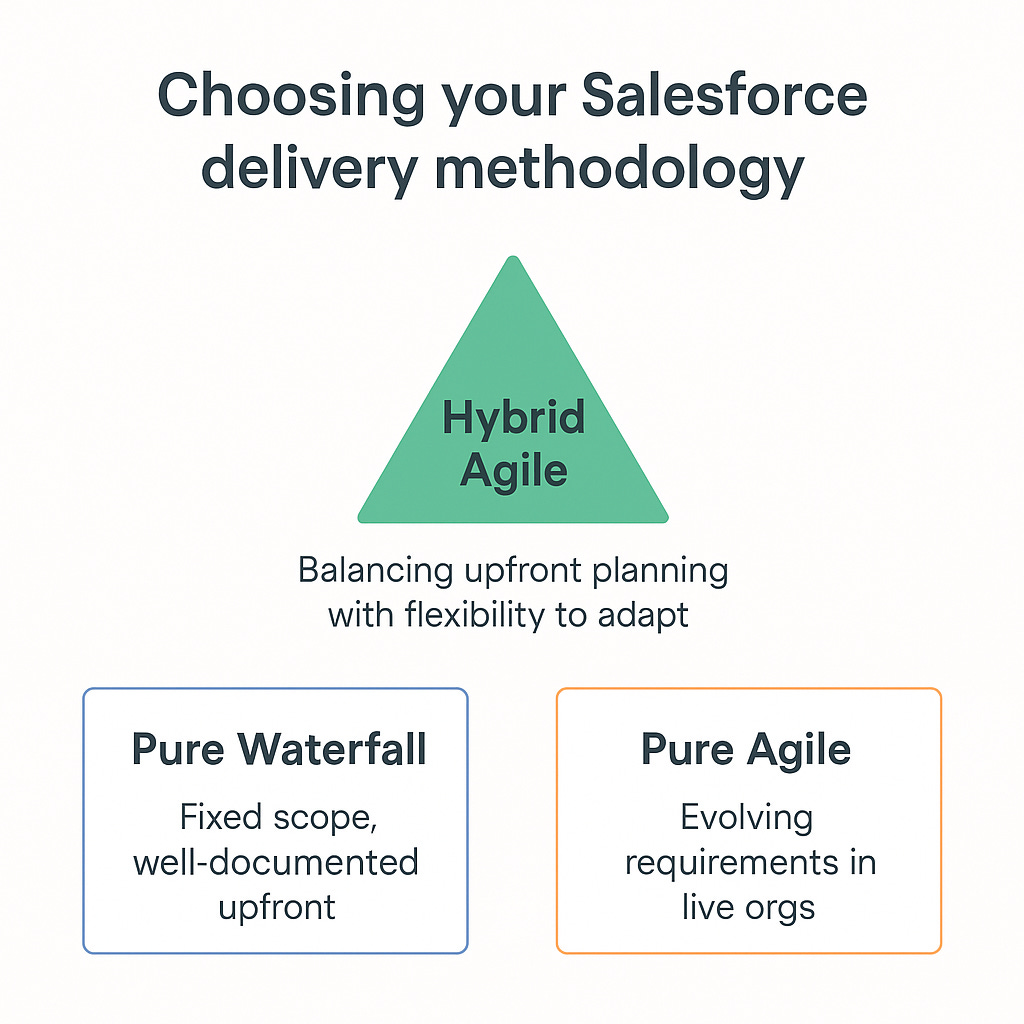
In the Salesforce End-to-End Implementation Handbook, author Kristian Margaryan Jørgensen outlines three common approaches:
📌 Pure Waterfall: Works when your scope is fixed and well-documented upfront.
📌 Pure Agile: Best for live orgs where requirements evolve over time.
📌 Hybrid Agile: The pragmatic choice for most programs, balancing upfront planning with the flexibility to adapt.
“The purpose of hybrid agile delivery is to have some indication of cost and solution architecture, but not to the extent that too much time is spent on determining all the lowest-level details upfront – at the cost of the requirements becoming stale before the project’s development phase can commence.”
💡 Want more frameworks like this? The book is packed with insights on delivering enterprise-grade Salesforce programs with less stress and more clarity.
That’s a wrap for now!
We hope this issue gave you practical tools, some real-world perspective, and maybe even a few new questions to ask before your next build vs buy decision. Whatever you choose – build smart, buy wisely, and don’t forget to listen to your users.
Hopefully, after reading this issue, you’re not sweating buckets over the build vs buy decision… unlike this guy:

🙋 We’d Love Your Feedback
Help us shape future editions of Salesforce Pulse.
Share your thoughts by filling out this quick form
📣 Talk to the community
We’re looking for Salesforce professionals – architects, consultants, admins, devs – to contribute insights and experiences. You can:
🔹 Write a guest article or opinion piece
🔹 Share a case study or success story
🔹 Participate in an interview or expert Q&A
🔹 Provide technical tips or walkthroughs
🔹 Collaborate on a recurring column
Fill out this form and let us know
If you wish to connect with me, feel free to reply or DM me on LinkedIn